In Catalonia, this pursuit of financial regulation took the pioneering form of the creation of the Taula de Canvi de Barcelona [Barcelona Exchange Bank] in 1401, one of the first public banking institutions in Europe. The Taula, established by the Consell de Cent [Council of One Hundred] municipal government, was tasked with managing deposits and providing loans in a context of sweeping economic expansion. This institution not only regulated financial transactions, but also protected citizens from usurious practices. In Lleida, the Taula de Canvis i Dipòsits [Exchange and Deposits Bank], established in 1585 under a royal privilege granted by Philip II, followed the same model, establishing itself as a municipal bank to receive deposits and finance commercial projects, as documented in its general ledger between 1589 and 1775 .
From the Taules de Canvi to central banks
Regulation of the financial system has been a core pillar for Europe’s economic development, including the establishment of institutions to manage credit, guarantee stability and promote trade. This process began in the late Middle Ages with the emergence of public and private banks that transformed the continent’s economic dynamics. An emblematic example is 15th-century Medici Florence, where family banks not only financed trade and art, but also established credit mechanisms that impacted the European economy. Many centuries later, this regulation evolved into modern institutions such as today’s European Central Bank, responsible for ensuring the monetary stability of the European Union.

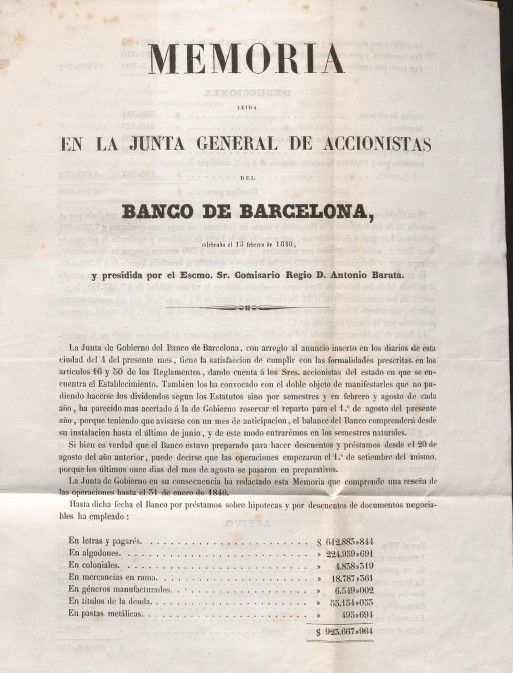
That institution contributed to local economic stability, combating the risks of banditry and monetary diversity, until its disappearance in the late 18th century. Later, the financial system’s modernization was reflected in institutions such as the Banc de Barcelona [Bank of Barcelona], whose annual accounts between 1846 and 1876 show accounting management and credit promotion in a context of industrial growth.
By the late 19th century, the legacy of these practices could be seen in the promotion of savings banks, such as the Caixa de Pensions per a la Vellesa, founded in 1904, which combined savings and social welfare, influenced by European currents of cooperativism and solidarity.
By the late 19th century, the legacy of these practices could be seen in the promotion of savings banks, such as the Caixa de Pensions per a la Vellesa, founded in 1904, which combined savings and social welfare, influenced by European currents of cooperativism and solidarity.