- Date
- 1901 - 2000
- Archive
- Municipal Archive of Girona
- Document type
- Audiovisual/sonor
- Reference code
- CAT-CRDI
- Description
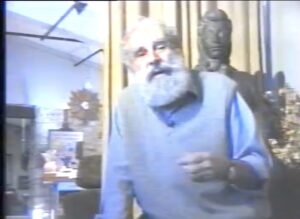
This is an interview with Alexandre Deulofeu i Torres (1903-1978), chemist, politician and philosopher of history, author of The mathematics of history, a cyclical and deterministic theory about the evolution of civilizations throughout history. This interview was recorded in 1975 by Josep Maria Benejam and Sebastià Delclòs (Pitruc). In 2022 the Image Research and Diffusion Center (CRDI) digitized it. During the interview, Deulofeu comments on various aspects of his theory, known as the Mathematics of History, and makes predictions about the future based on historical cycles.
In this interview, Deulofeu talks about his recent return from Venezuela. He analyzes the future of world powers, highlighting Germany as the next economic power in Europe, the rising power of China and the decline of former colonial empires, such as the French, English and Spanish. In relation to Catalonia, Deulofeu affirms that it will be an “agent of exception” in history, highlighting it as the “mother of European culture” and arguing that the origin of Romanesque-Gothic culture is Catalan. He also predicts the final demise of the Spanish empire around 2029, based on the 550-year cycles of empires, and considers that the best attitude to this historical determinism is the peaceful acceptance of change.
The interviewee also explores the Catalan origin of Romanesque in the Rosselló area, stating that he came to this conclusion after several trips to Lombardy, France and northern Spain.
Many of his predictions, such as the dissolution of the Soviet Union and Yugoslavia, have come true, while others, such as the collapse of the United States, remain to be seen.
He was the main follower in Catalonia of the cyclical theories of history formulated by the German philosopher Oswald Spengler (1880-1936), although his conception was radically distanced from these due to his deep conviction in the values of democratic and progressive ideals.
This document is significant at the European level because the theories that Alexandre Deulofeu sets out on the cyclical nature of civilizations and on Romanesque art have a clearly global component and a vision that often breaks with academic canons.