Traditional economic activities, pillars of historical Catalonia
Traditional economic activities, often combined in a subsistence economy, shaped the landscape and identity of Catalonia over the centuries and have been fundamental to economic development. Agriculture has been, since time immemorial, one of the main pillars of the Catalan economy. Cereals such as wheat were cultivated, vineyards for wine production, and olive trees for olive oil, products that not only supported the local population but were also exported. Livestock farming also played a prominent role, especially in mountainous areas, where the raising of sheep, goats and cows provided wool, milk and meat, taking advantage of natural pastures. Fishing has been a key activity on the Catalan coast, from Maresme to the Ebro Delta. With techniques inherited from generations, they caught fish such as sardines or anchovies, which were essential for the Mediterranean diet and local trade.
The Book of the Remença Union
1448
The Book of the Remença Union of 1448 is the first Catalan document inscribed on the UNESCO Memory of the World register since June 2013. It contains the acts of the organization of men and women of remença from the dioceses of Girona, Osona, Barcelona, Urgell and Elna who fought against feudal abuses in medieval Catalonia. It reflects the social and economic tensions derived from the dependence of peasants on the land and the regime of manorial property, highlighting the first attempts at collective organization to defend agrarian rights. It is a key documentary witness to peasant resistance and the origin of trade union movements: in short, to the history of social movements and the claim of people’s rights.
Girona Municipal Archive
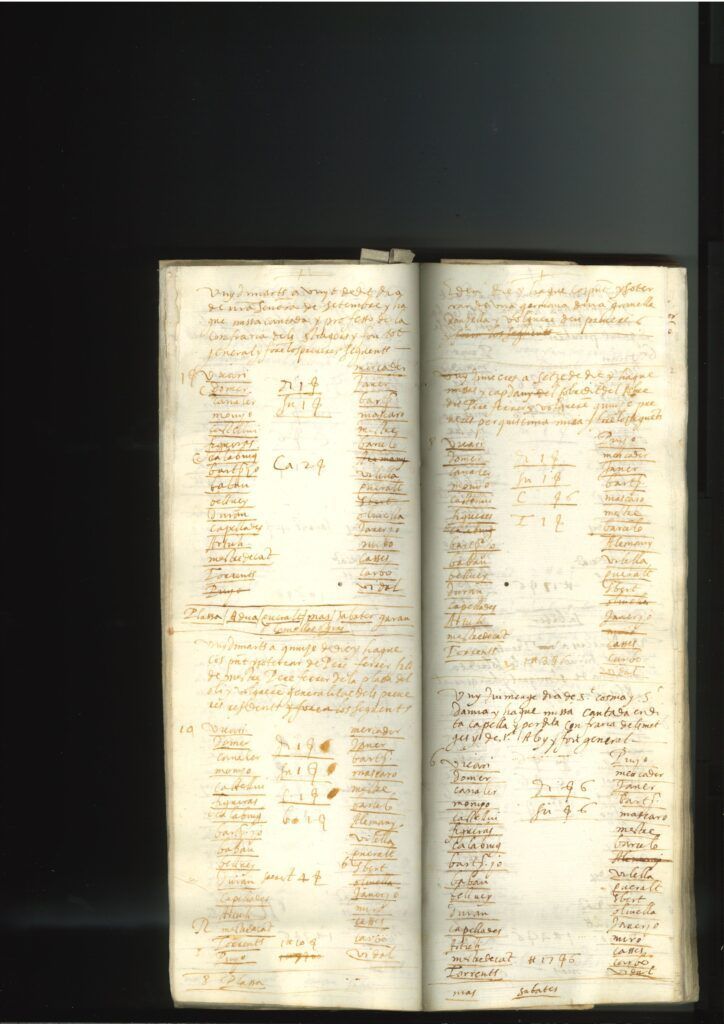
Book of the Brotherhood of Sant Galderic of the farmers of Sant Martí Sarroca
1670-1798
Book that covers the period between 1670 and 1798 and documents the activities of the Brotherhood of Sant Galderic, formed by farmers from Sant Martí Sarroca, in Alt Penedès. With a religious component, the brotherhood functioned as a mutual support organization for farmers in times of economic or social difficulty. It is an example of how rural communities organized collectively to protect their interests, a precursor model of modern cooperatives and unions.
Arxiu Comarcal de l’Alt Penedès
Atlas of the geometric plan of the rural properties of Gandesa
1867
Atlas that documents the delimitation of the rural lands of Gandesa, in the Terra Alta, in the context of the European standardization of the decimal metric system. This process replaced local measurement systems to facilitate the management of agriculture, a key traditional economic activity in the area. It is an example of how administrative modernization impacted the organization of agricultural property, establishing equivalences between traditional measures and the universal system.
Terra Alta County Archive
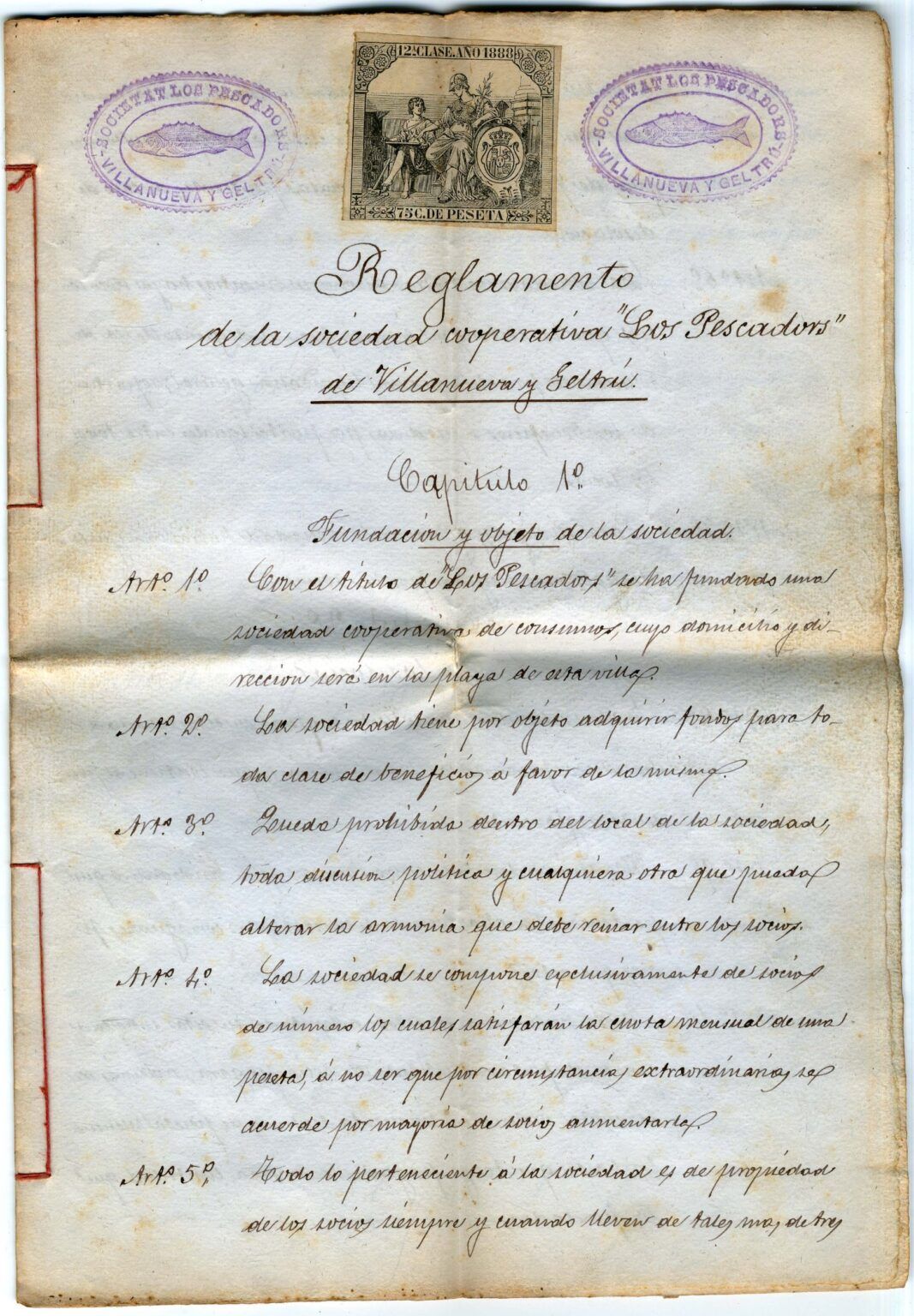
Regulations of the cooperative society “Los Pescadors” of Vilanova i la Geltrú
1891
Regulations that establish the operating rules of the cooperative society “Los Pescadors” of Vilanova i la Geltrú, created to defend the interests of local fishermen. Fishing, as a traditional economic activity on the Garraf coast, is reflected in this document that demonstrates the collective effort to structure and protect the traditional trade through the cooperative formula.
Garraf County Archive
Photograph of the Sant Miquel Fair in Lleida
1960
A snapshot of the Sant Miquel Fair in Lleida, an event with medieval roots that has been held since 1232 following the privileges granted by Jaume I. The fair, which connected merchants from Toulouse, Montpellier and other European cities, was a key point for the exchange of agricultural and livestock products. From the 1960s, it was complemented by an international fruit congress. It is an example of the continuity of this commercial tradition and its international projection, linked to the traditional agricultural economy.
Historical Archive of Lleida
Fair of Sant Josep de Mollerussa
1969
Photograph of the Sant Josep de Mollerussa Fair, an event where farmers, livestock farmers and traders gather to exchange products and technologies related to agriculture and livestock. The fair, still active, shows the importance of traditional economic activities in the Pla d’Urgell, a region marked by irrigation and agricultural production. In Catalonia, the historical continuity of fairs like this is a commitment to the existence of commercial and social meeting spaces and local economic development.
Pla d’Urgell County Archive