The development of the railway network in Catalonia
The development of the railway network in Catalonia, which began with the Barcelona-Mataró line in 1848, revolutionized the mobility and economy of the territory. This system connected rural areas with industrial centers, promoting commercial exchange and social cohesion. The expansion of the lines throughout the 19th and 20th centuries responded to a growing demand for transport, consolidating an infrastructure that became essential for modernization. The railway, as a collective service, illustrates the Catalan capacity to adapt to the challenges of contemporaneity. Its construction involved coordination between private and public initiatives, with a notable impact on the urban fabric. The stations became meeting points and local development.
Panoramic view of the iron bridge of El Vendrell at the end of the 19th century
1888-1900
This photograph, by unknown author, is the oldest preserved of the iron bridge over the La Bisbal del Vendrell stream. The bridge witnessed the passage of the first train in 1864, a historic event for the people of Vendrell. Destroyed by Republican troops on January 20, 1939, it was rebuilt with reinforced cement. The image highlights the importance of the railway in local development and its structural evolution over time.
Baix Penedès County Archive
Inauguration of the aerial railway at the Tibidabo Amusement Park
1915
Inauguration of the recreational aerial railway at the Tibidabo Amusement Park in Barcelona in 1915, a unique event in the advancement and adaptation of railway technology applied to leisure. It is a significant aspect in the urban and social history of Barcelona and in particular of the amusement parks of the 20th century.
National Archive of Catalonia
Group of people surrounding a locomotive at the Nord station, in Barcelona
1917
Group of people gathered around a locomotive at Barcelona’s North Station, one of the city’s main railway infrastructures. The document is a visual testament to the daily and social activity linked to train stations, as well as its ability to illustrate the central role of the locomotive as a symbol of technological progress and urban connectivity in the Catalan context of the early 20th century.
National Archive of Catalonia
Inauguration of the first section of the Trans-Pyrenees Railway
1919
Inauguration of the first section of the Trans-Pyrenees in 1919, one of the three railway lines through the Pyrenees defined in the 1904 agreement between the French Republic and the King of Spain. The Ripollès region thus became a connecting route, initially evolving to remain in the 21st century up to the Tor de Querol. It was a railway project with international ambitions that reinforced the integration of the region into a cross-border transport network.
Ripollès County Archive
Scheme of stations on the Trans-Pyrenees Railway line between Lleida and France
1926-1950
1:2,000 scale diagram of the stations on the railway line from Lleida to Saint Gironç (France). The line, conceived as a major international connection of 850 km between the Spanish and French states, began in sections, with the Lleida-Balaguer segment inaugurated in 1924 and arriving at La Pobla de Segur in 1951, where it ended without achieving its ambitious cross-border connection.
Pallars Jussà County Archive
Train carriages painted by the Professional Union of Illustrators with anti-fascist propaganda
1936
This image documents the use of train carriages as support for anti-fascist propaganda produced by the Professional Union of Illustrators during 1936, within the framework of the Civil War. The carriages, essential elements of the railway system, were used as a tool of political communication, highlighting their importance not only as a means of transport, but also as a vehicle for ideological dissemination in the context of the war.
National Archive of Catalonia
Photomontage about the railway
1930
Photomontage of the years of Republican Catalonia that offers an artistic representation focused on the railway, highlighting its significant presence in the society of the time. Its relevance lies in its ability to reflect the cultural and technological impact of the railway, a key means of transport in the economic and social development of Catalonia during the 20th century, through an avant-garde visual expression.
National Archive of Catalonia
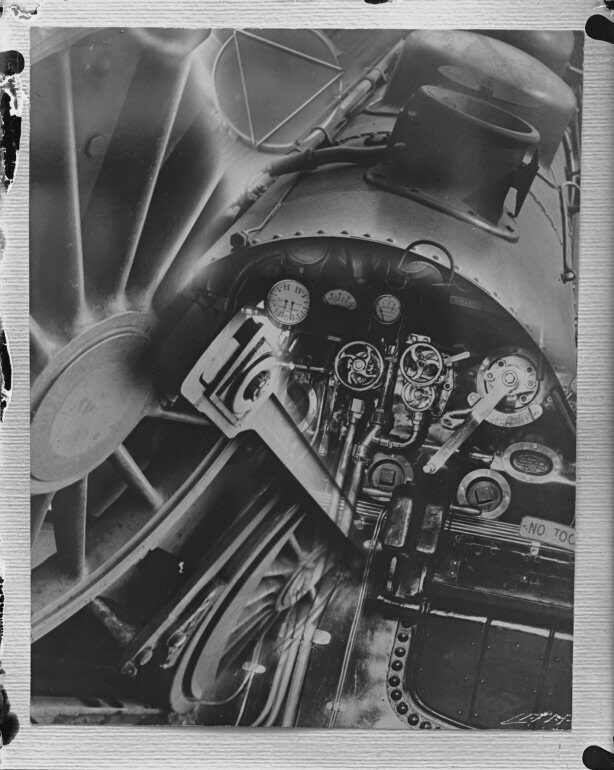
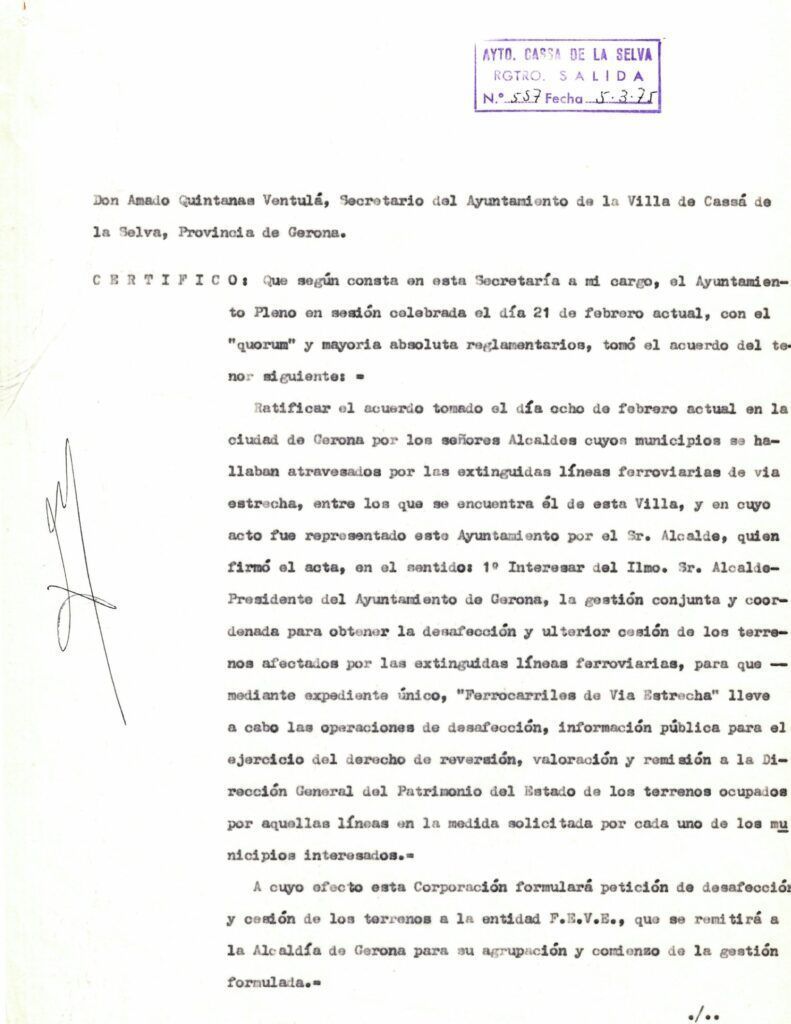
Acquisition of the land of the old Carrilet de Girona in Sant Feliu de Guíxols
1975
Record of the acquisition of the land of the old narrow-gauge railway, the popular Carrilet, which connected Girona with Sant Feliu de Guíxols, in operation between the end of the 19th century and 1969. This infrastructure acted as an economic engine for the municipalities through which it passed. After its disappearance, the land was the subject of a long process of reversion that culminated in the creation of a greenway, contributing to the promotion of a new model of sustainable tourism.
Cassà de la Selva Municipal Archive