Industrialization and trade in Catalonia: lights and shadows of an engine of change
Industrialization in Catalonia during the 19th century, led by the textile sector, represented a profound transformation of the economy and society, driven by innovations such as the power loom and expansive trade with Europe. This process generated unprecedented urban and technological growth, consolidating an emerging bourgeoisie, but also revealed inequalities and tensions, and a world of work often marked by labor exploitation and strikes and workers’ demands. The industrial colonies of the main river basins exemplify this duality of innovation and precariousness, while commercial expansion positioned Catalonia as an industrial benchmark and economic center. The ambivalent legacy of industrialization and trade combines modernization and social challenges.
“General Register of Yarn Manufacturers”
1829
This document, prepared in 1829 by the Commission of Fabrics, Textiles and Stamps Factory of Cotó, collects a detailed list of the textile factories existing in Barcelona at that time, constituting an essential source for understanding the industrial activity and the development of the textile sector in the context of trade and the Catalan economy of the 19th century It stands out for its historical relevance, as it provides a precise vision of the productive structure of one of the economic drivers of the city at the beginning of a new cycle of industrial transformation.
National Labour Promotion
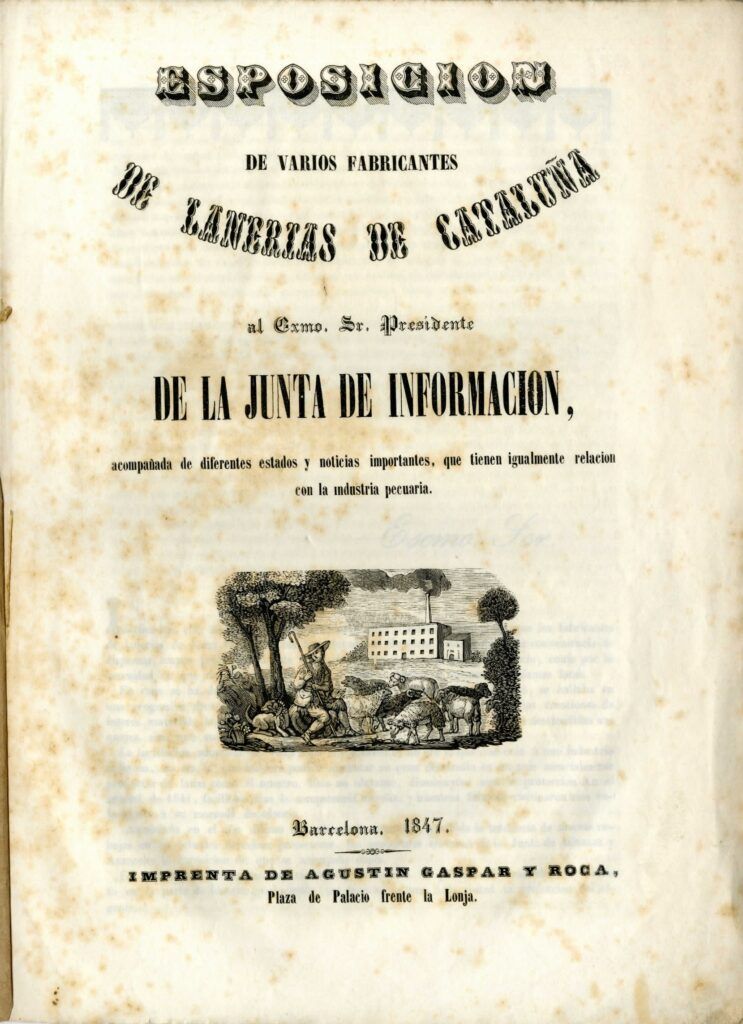
Exhibition of several Barcelona lath manufacturers
1847
Exhibition carried out by various tire manufacturers in Barcelona, accompanied by relevant statistics and news related to both the textile industry and the livestock industry, with a detailed view of the conditions and interests of the manufacturing sector in the mid-19th century. The text highlights the interconnections between different productive branches and the current project in the institutional sphere of the time.
National Labour Promotion
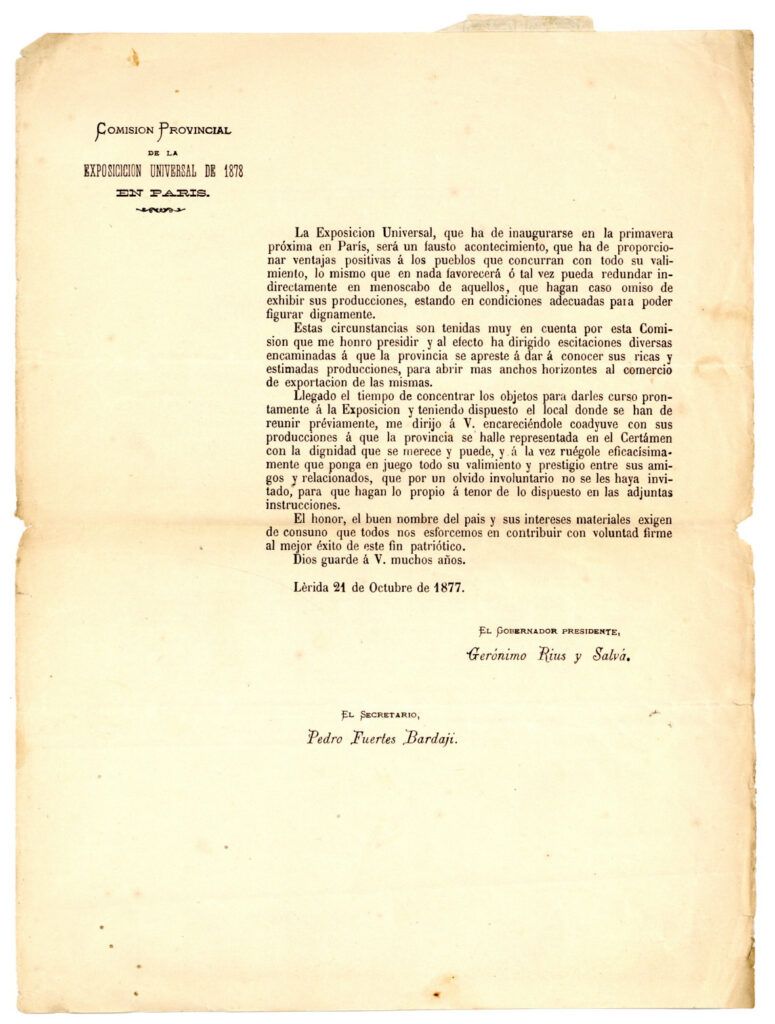
Paris Universal Exhibition
1878
The Association of Salt Manufacturers of Gerri will participate in the 1878 Universal Exhibition in Paris, an event of great international importance that will allow it to donate to conèixer the production of salt and project the latest activity in the local area. This document demonstrates the historical and economic importance of the salt industry in the area, as well as its capacity to establish links in the context of the international relations of the time.
Pallars Sobirà County Archive
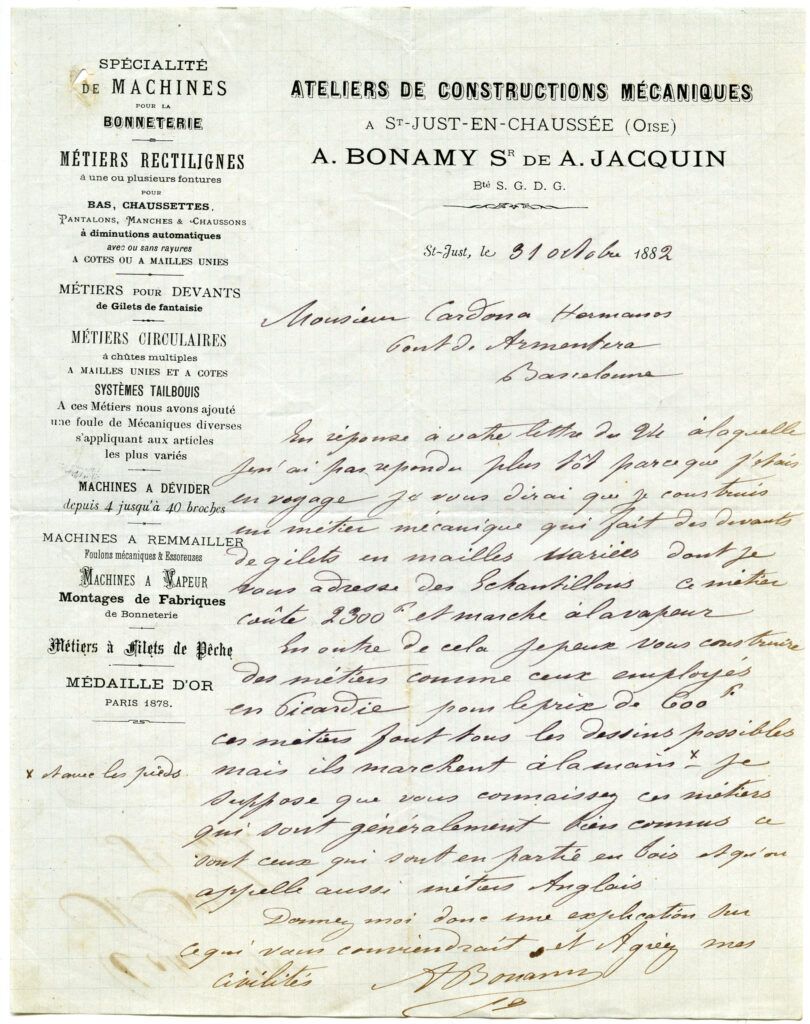
Letter from A. Bonamy Successeur de A. Jacquin to the Cardona Hermanos firm, from Pont d’Armentera
1882
This letter, dated October 31, 1882, was sent from France to the Cardona Hermanos company, established at the Pont d’Armentera. It’s a shame to be a small town, it will bring together a textile company that will prosper, expanding to several Valls, Vallmoll, Santa Coloma de Queralt and Barcelona, and marketing its products to Spain, France and Italy. This exchange of epistolary evidence with technical innovations, primary materials and markets transcending borders, reflects the ability of a local firm to integrate into an international commercial network and contribute to economic development.
Alt Camp County Archive
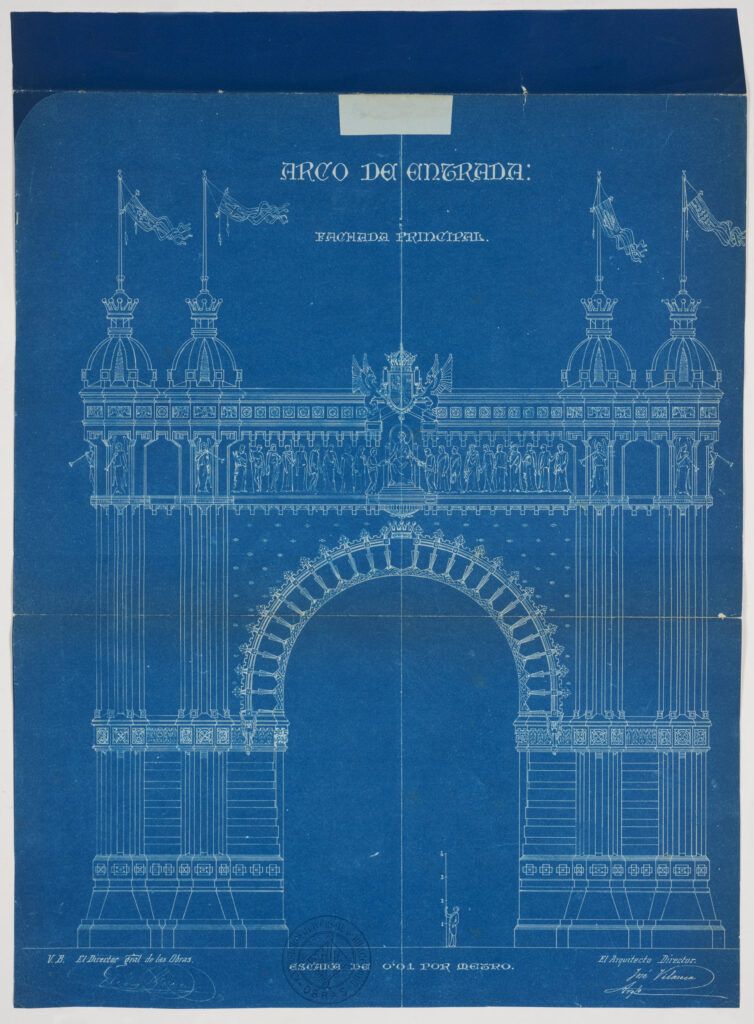
Definitive Alçat de l’Arc de Triomf, by Josep Vilaseca
1887
This definitive alçat of the Arc de Triomf, prepared by Josep Vilaseca in 1887, constitutes one of the iconic documents of the International Exposition of 1888, a fundamental event for the economic and social projection of Barcelona around the world. One of the objectives of the Exhibition was also to position Barcelona and Catalonia as an advanced industrial and commercial territory, which would compete with the main European capitals such as Paris or London.
Barcelona Municipal Archive
Camil Mulleras factory staff in Poblenou
1897
This photograph portrays the staff of the textile factory of the industrialist Camil Mulleras in Poblenou, one of the epicenters of industrialization in metropolitan Barcelona. It is an image that also highlights one of the most problematic facets of industrialization, child labor, reflecting the working conditions of the time. This is a visual document that highlights both the economic importance of the textile sector and its social implications at a time when Barcelona was culminating in the municipal aggregations of the towns of the plain of Barcelona, such as Sant Martí de Provençals.
Barcelona Municipal Archive
Photograph of the staff of the Salvador Punsola factory
1899
Staff from the Salvador Punsola textile factory, including children’s workers. In the context of commerce and the economy, this image testifies to the rise of the textile industry with the economic engine of Canet de Mar from the beginning of the 20th century to the end of the 1970s.
Municipal Archive of Canet de Mar
Photography of Colònia Rosal
1908
This photograph of Colònia Rosal documents a key element in the history of commerce and the Catalan economy: founded in 1858, Colònia Rosal is recognized as the first industrial colony in Catalonia, established by the Law of Colonies, a legal framework that will give definitive impetus to the process d’industrialització of the region. Its creation and development reflect the entrepreneurial spirit and the economic transformation of the 19th century, consolidating with a fundamental precedent in the industrial evolution of Catalonia.
Municipal Archives Network (XAM): Olvan Municipal Archive
Drawing of the premises of the Industrial University
1923
This drawing, published in 1923 in the work “The Work Realized: Anys 1914-1923. Mancomunitat de Catalunya” represents the premises of the Industrial University, at the old site of the Can Batlló factory. It is an example of the conversion of an old manufacturing facility into a new benchmark in technical and industrial education, a cultural and educational achievement that lasts until now.
General Archive of the Barcelona Provincial Council. Reserve Library of the Provincial Council of Barcelona and Documentation Center of the General Archive
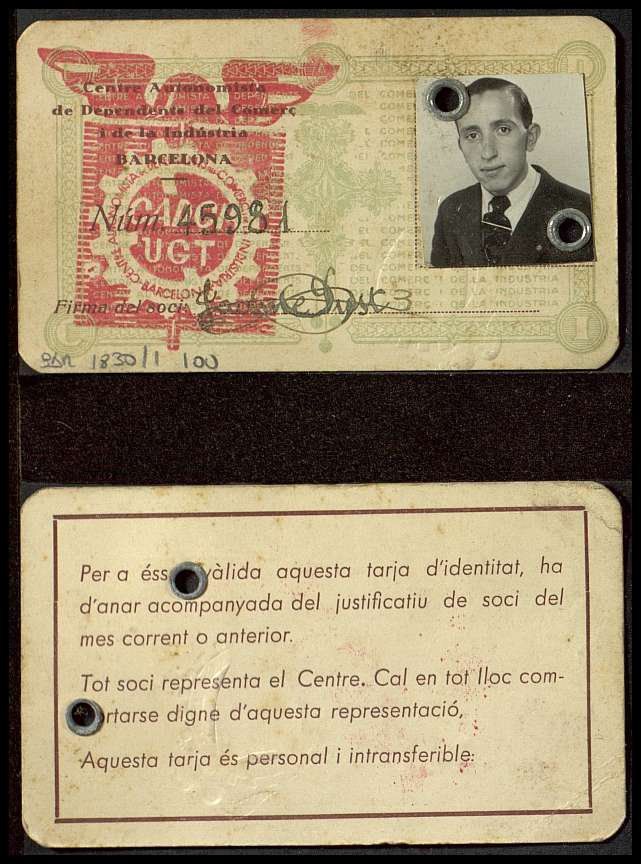
Barcelona CADCI membership cards
1936
Cards of workers affiliated with the Center Autonomista de Dependents del Comerç i de la Indústria de Barcelona in 1936, the entity linked to the Catalan movement during the first decades of the 20th century and in particular during the years of the Republican Generalitat. It is a documentary testimony of the citizen participation and the social organization of the establishment of the Franco dictatorship, which was suppressed and its most confiscated.
National Archive of Catalonia
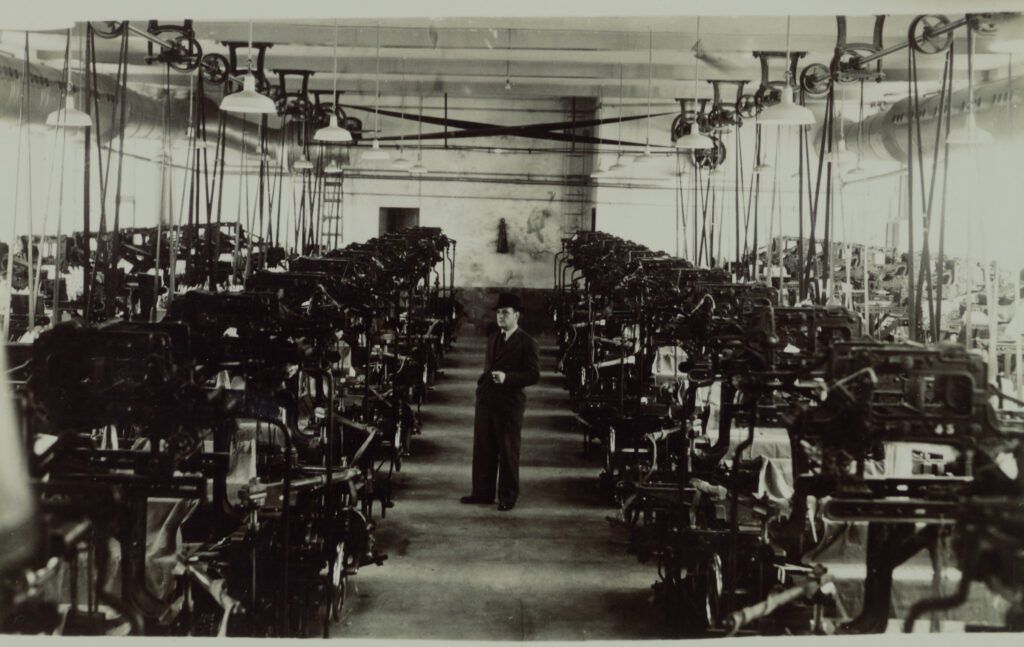
Photographs of the embers and fabrics of the Cal Xiquet textile factory in Prats de Lluçanès
1940
This photograph shows the walls and floors of the Cal Xiquet textile factory, a visual testimony of the importance of the textile sector in the small towns of the interior of Catalonia. In the context of trade and the economy, the textile industry will represent a significant change in localities such as Prats de Lluçanès, transforming the economic and social structure of these mainly rural communities.
Xarxa d’Arxius Municipals (XAM): Municipal Archive of Prats de Lluçanès
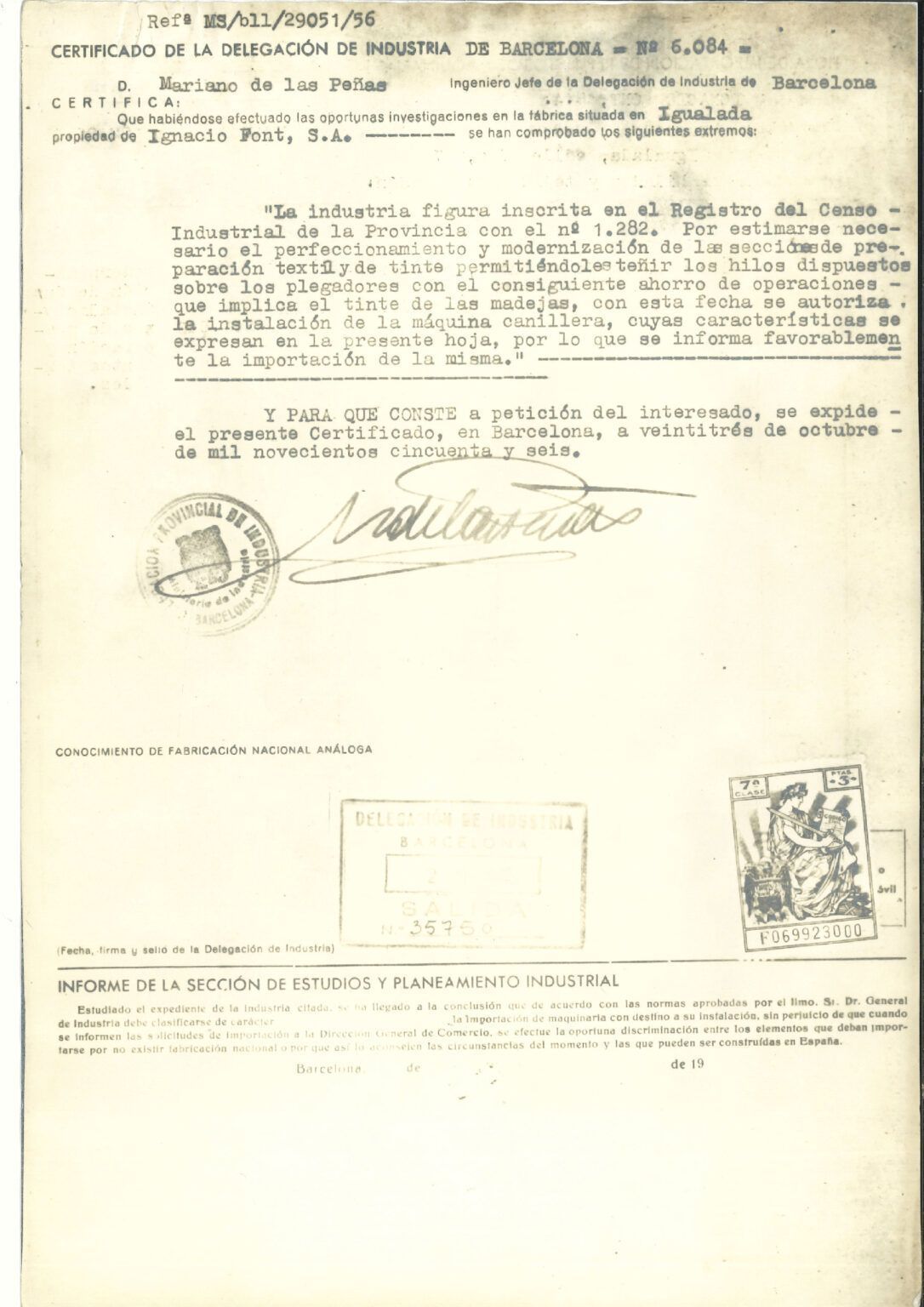
Request from a textile company from Igualada to the Ministry of Industry to import foreign machinery
1956
This request from a textile company in Igualada to import machinery that it could not buy from Spain shows the economic limitations of the Franco regime, which has already overcome the immediate post-war period. It is also an example of the will to modernize the textile industry, a key sector for the Anoia economy.
Anoia County Archive
Catalog of the ceramic factory Industrias Miret del Vendrell
Between 1955 and 1965
Catalog of the activities of the ceramic factory Industrias Miret al Vendrell, specialized in the production of vermella-mate rajola. The company, founded in 1942 by Francesc Miret Soler, will transform the territorial artisanal activity into a successful industrial initiative. The new production and the new commercial expansion, both at the local and regional level and internationally (Australia, States Units, Jordan, Iran, Canada), will turn the company into a key reference for the industrial activity of Vendrell during the second half of the 20th century.
Baix Penedès County Archive
Label of the Chartreuse liquor manufactured in Tarragona
1960
The Chartreuse liqueur brand constitutes one of the emblematic references of the city of Tarragona and has a notable historical relevance, exemplified in this document. The cartoixans, coming from “La Grande Chartreuse” from Grenoble, have established a new distillery in Tarragona in 1882 and, starting in 1901, they will begin the production of their liquor, a process that will remain active until the end of 1971.
Historical Archive of Tarragona

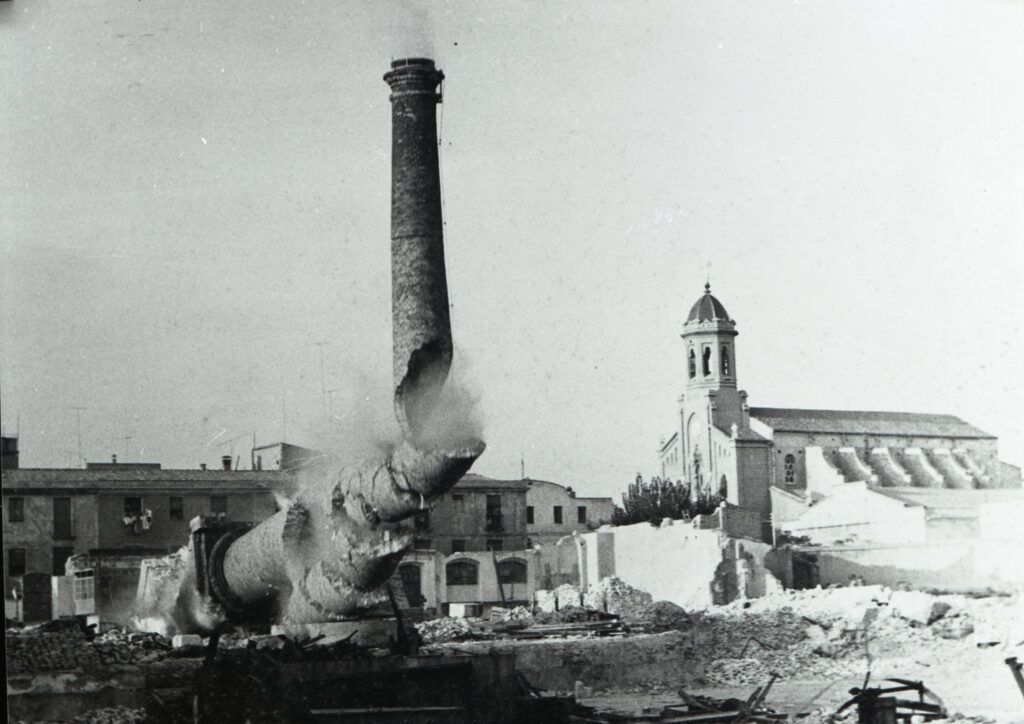
Blasting of the xemeneia darrera of the old Mar factory, Vilanova i la Geltrú. Author Jordi Más i Morando
1963
This image documents the blowing up of the xemeneia of the Mar a Vilanova i la Geltrú factory, marking the end of a textile industrial stage in the 20th century. It is a document that, undoubtedly, is a glimpse into the profound changes of the Catalan economy during the second half of the century, adapting to the economic transformations of the country and the new international context.
Garraf Regional Archive